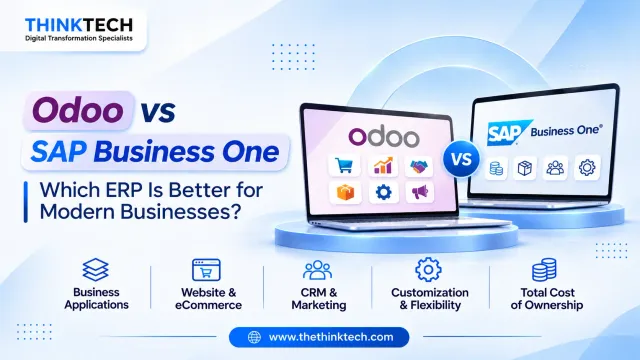
Across Calgary and Edmonton, growing companies tend to hit the same wall. The fabrication shop running on QuickBooks and spreadsheets. The oilfield services company tracking crews, equipment and field work in three different systems. The distributor whose inventory counts never quite match the books. When the conversation turns to ERP, two names come up often: Odoo and SAP Business One.
Both are capable systems. But for most growing Alberta businesses, Odoo is the better fit. It runs more of the business in one platform, it’s built for the browser, the phone and the job site, and its all-apps pricing keeps costs predictable as you grow.
Here’s how the two compare, and why ThinkTech, a Calgary-based Odoo implementation partner, recommends Odoo to manufacturers, energy services companies, contractors and distributors across Calgary and Edmonton.
1. Odoo and SAP Business One at a Glance
What Is Odoo?
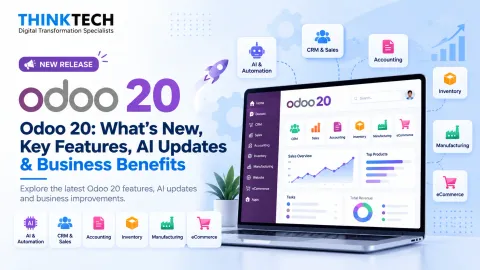
Odoo is a modular business platform that brings ERP, CRM, website, eCommerce, marketing, field service, HR and more into one system. Every app shares the same database, so information entered once is available everywhere. You start with the apps you need and switch on more as you grow. The latest version, Odoo 20, was released in September 2026.
Odoo’s apps cover the whole business:
- Finance: Accounting, Invoicing, Expenses
- Sales: CRM, Sales, Point of Sale, Subscriptions
- Operations: Inventory, Purchase, Manufacturing, Quality, Maintenance, PLM
- Services: Project, Timesheets, Planning (including Field Service), Helpdesk, Rental
- Website: Website Builder, eCommerce, Live Chat
- Marketing: Email, SMS and Social Marketing, Marketing Automation, Events, Surveys
- HR: Employees, Recruitment, Time Off, Appraisals
You can browse the full list of Odoo business applications on Odoo’s website. (This article refers to Odoo Enterprise, the subscription edition with the full app suite. Odoo Community, the free open-source edition, includes fewer apps.)
What Is SAP Business One?
SAP Business One is SAP’s ERP for small and midsize companies. It covers financials, sales, purchasing, inventory, production and MRP, service management and reporting. It’s sold and implemented through SAP partners, and many capabilities beyond core ERP, such as eCommerce, HR and equipment rental, come from partner add-ons or separate products. The official SAP Business One features page lists its capabilities.
2. Why Odoo Comes Out Ahead
One connected system, from inquiry to invoice
Here’s how an order can flow for a Calgary fabrication shop running Odoo:
- A customer submits a quote request through the company website.
- The request lands in CRM as an opportunity and is assigned to a salesperson.
- The salesperson sends a quotation, and the customer accepts and signs it online.
- Confirming the order can create a manufacturing order, reserve materials and trigger purchase orders for anything missing.
- Production, quality checks and delivery are recorded as the job moves through the shop.
- The invoice goes out, the payment is reconciled, and the job’s profitability shows up in reporting.
- If the customer has an issue later, Helpdesk has the full order history.
No re-keying between systems, no integrations to maintain, and no guessing which spreadsheet is current. With SAP Business One, several of those steps would typically run in separate tools connected to the ERP.
Every app, one price
Odoo’s Standard plan includes every app for one per-user price. CRM, eCommerce, helpdesk, marketing and project management aren’t extra products to buy, license and integrate. You simply switch them on when you need them.
Built for the web, mobile and the job site
Odoo runs in any browser and on mobile, so office staff, shop floor operators and field crews all work in the same system. Odoo 20 also added an offline mode: records can be viewed, edited and created during short connectivity drops and sync automatically once the connection is back, which helps crews at remote sites with patchy coverage.
AI that runs processes, not just answers questions
In Odoo 20, you can describe a process to an AI agent in plain language, such as assigning new leads to the right salesperson, creating a project when a contract is signed, or alerting you when stock runs low, and the agent sets it up and runs it. These agentic AI features are part of Odoo’s Custom plan.
Website, eCommerce and customer portal built in
For distributors and manufacturers that sell online, Odoo’s website and eCommerce apps run on the same database as inventory and accounting. Online orders flow straight into fulfilment and invoicing, and B2B customers can log in to a portal to see their quotes, orders and invoices.
Easy to adapt as you grow
Much of Odoo can be configured without code. Odoo Studio (on the Custom plan) lets you add fields, screens and automations, and Odoo’s open development framework supports custom modules when you need them. A new major version every year keeps the platform moving forward.
3. Odoo vs SAP Business One: Feature Comparison
| Area | Odoo | SAP Business One | Edge |
|---|---|---|---|
| Accounting and finance | Built in, with automatic bill matching to purchase orders | Built in, a long-standing strength | Even |
| Inventory and warehouse | Multi-warehouse, barcode, lots and serials, suggested reordering | Multi-warehouse, batches and serial numbers | Even |
| Manufacturing | MRP, bills of materials, shop floor tablets, Quality, Maintenance, PLM | Production and MRP; more through partner add-ons | Odoo |
| CRM | Full CRM app | Opportunities and activities within sales | Odoo |
| Projects and job costing | Project, Timesheets and analytic accounting | Project management, expanded in recent releases | Odoo |
| Field service | Field Service in Planning: worksheets, customer sign-off, live map | Service calls and service contracts | Odoo |
| Equipment maintenance | Preventive and corrective maintenance app | Mostly through partner add-ons | Odoo |
| Equipment rental | Rental app | Through partner add-ons | Odoo |
| Website and eCommerce | Built in | Through integrations and partner solutions | Odoo |
| Marketing | Email, SMS, social and marketing automation | Campaign management; more through partners | Odoo |
| Helpdesk | Dedicated Helpdesk app | Service calls within service management | Odoo |
| HR | Employees, Recruitment, Time Off, Appraisals | Employee records; HR through partner add-ons | Odoo |
| Customization | No-code Odoo Studio plus an open framework | SDK, APIs and partner add-ons | Odoo |
| Deployment | Odoo Online (cloud), Odoo.sh or on-premise | On-premise or partner-hosted cloud | Odoo |
| User experience | Web and mobile, with offline mode | Desktop client plus a growing web client | Odoo |
| Parent company already on SAP | Connects through APIs | Native to the SAP family | SAP |
SAP Business One concentrates on core ERP and relies on partners for much of the rest. Odoo runs the whole business in one platform, from the website to the warehouse floor to the job site. Both support Canadian sales taxes (GST, PST and HST) and CAD/USD transactions, which matters for Alberta companies that buy from or sell into the US.
4. Odoo for Calgary and Edmonton Industries
Alberta’s economy looks different from Toronto’s or Vancouver’s, and so do its ERP needs. Here’s how Odoo fits the industries that drive business across the Calgary and Edmonton regions.
Manufacturing and fabrication
From metal fabrication and machining shops in Calgary’s industrial parks to equipment and wood products manufacturers around Edmonton, Alberta manufacturers need tight control of bills of materials, work orders, purchasing and job costs.
Odoo puts Manufacturing, Quality, Maintenance and PLM in the same system as sales and accounting, with tablets on the shop floor so operators record work as it happens. Odoo 20 adds continuous production, where operators register quantities on a work order and the next operation is released automatically, along with side-by-side bill of materials comparison and drag-and-drop rescheduling of manufacturing orders. SAP Business One covers production and MRP, but shop floor control, quality and maintenance usually mean extra add-ons.
Energy and oilfield services
Calgary is the head-office base for much of Canada’s energy sector, and the Edmonton region, including Nisku and Leduc, is home to many of the service, rental and fabrication companies that support it. These businesses track crews, equipment, rentals and job costs across many sites.
Odoo handles this in one system. Field Service, now part of the Planning app, schedules on-site work, records it on custom worksheets, tracks the time and materials used, bills the customer and produces a report for the customer to sign. Rental and Maintenance keep equipment available and in service, and offline mode helps when crews lose signal on site. With SAP Business One, much of this would come from separate partner add-ons.
Construction and trades
Contractors in both cities juggle estimates, purchasing, subcontractors and timesheets across many jobs at once. Odoo’s Project, Timesheets, Purchase and analytic accounting give every job its own cost and profitability view, with field teams logging time from their phones. Odoo 20 also includes a General Contractor industry package with section templates for quoting frequent work quickly.
Wholesale, distribution and logistics
With major rail, highway and air cargo links, Calgary and Edmonton serve as distribution hubs for Western Canada and the North. Odoo gives distributors multi-warehouse inventory, barcode operations, eCommerce, a B2B customer portal and CRM in one platform. Odoo 20 suggests minimum and maximum stock levels based on recent sales and drafts the purchase order for you, rates vendors on quality, and matches vendor bills to purchase orders automatically, flagging any discrepancy.
Agriculture and agri-food
Alberta’s agri-food processors, ag equipment dealers and farm suppliers need lot traceability, quality records and seasonal inventory planning. Odoo covers lot and serial tracking, quality checks and eCommerce in one system, and Odoo 20 adds an Agri-Equipment Rental industry package for managing rental and maintenance of tractors, harvesters and other farm machinery.
5. Pricing and Total Cost of Ownership
Licence price is only one part of what an ERP costs. A fair comparison includes:
- Software subscription or licences
- Implementation and data migration
- Customization and integrations
- Add-ons and third-party apps
- Hosting and infrastructure
- Training and ongoing support
How Odoo is priced
Odoo charges per user, per month. The Standard plan includes every app, hosted on Odoo Online. The Custom plan adds Odoo Studio, multi-company, external API access, agentic AI and the option to host on Odoo.sh or on-premise. Current rates are on Odoo’s pricing page, and implementation is quoted separately by your partner.
How SAP Business One is priced
SAP Business One is sold through SAP partners, as perpetual licences with annual maintenance or as a subscription, priced by user type (for example, Professional or Limited users). The database, hosting and each partner add-on are often separate costs.
Why Odoo usually costs less to run
Most growing businesses need more than core ERP. Once you add CRM, eCommerce, field service, rental, maintenance or helpdesk, SAP Business One typically means extra add-ons, each with its own licence, integration and upgrade path. With Odoo, those apps are already included.
The useful comparison isn’t Odoo’s price against SAP’s price. It’s the total cost of all the software your business needs to run, and that’s where Odoo stands out.
6. Already on SAP Business One?
SAP has been moving Business One toward its web client, and its next major release, Version 11, is expected in 2027. If an upgrade project is coming either way, it’s the right moment to compare it with a move to Odoo.
Customers, vendors, products and opening balances can be migrated, and many companies time the switch with a fiscal year-end. ThinkTech can map how you use SAP Business One today, show you how the same processes run in Odoo, and plan a clean migration.
Staying on SAP can still make sense if your parent company standardizes on it or you depend on an add-on that only exists for SAP Business One. For most independent Alberta SMEs, though, Odoo offers more for the money.
7. The Verdict
SAP Business One is a solid ERP for core financials and operations. But growing Calgary and Edmonton businesses rarely stop at core ERP. They need CRM, field service, rental, maintenance, eCommerce and mobile access, and they need it all to work together.
That’s where Odoo wins. One platform, one database, every app included, and a system your office, shop floor and field crews can all use. For most manufacturers, energy services companies, contractors and distributors in Alberta, Odoo is the smarter ERP choice.
Frequently Asked Questions
Is Odoo better than SAP Business One?
For most growing small and midsize businesses, yes. Odoo covers ERP, CRM, field service, eCommerce, marketing and helpdesk in one platform with all apps included, while SAP Business One relies on partner add-ons for much of that. SAP Business One mainly makes sense if you already run it well or your parent company standardizes on SAP.
What is the main difference between Odoo and SAP Business One?
Scope. Odoo is a broad, modular platform that runs most of the business in one system. SAP Business One focuses on core ERP and relies on partner add-ons and integrations for areas like eCommerce, marketing, rental and HR.
What’s new in Odoo 20?
Odoo 20, released in September 2026, adds AI agents that can set up and run processes from plain-language instructions, an offline mode, continuous production in Manufacturing, suggested reordering in Inventory, and Field Service built into the Planning app.
Does Odoo handle Canadian sales tax and US dollars?
Yes. Odoo’s Canadian accounting localization supports GST, PST and HST, and Odoo handles CAD and USD transactions in the same system.
Is Odoo a good fit for Alberta manufacturers and oilfield services companies?
Yes. Odoo’s Manufacturing, Quality and Maintenance apps suit fabrication and machining shops, and its Planning (with Field Service), Rental and Project apps suit service companies that track crews, equipment and jobs across many sites.
Is Odoo cheaper than SAP Business One?
Usually, once you count everything a business needs. Odoo includes every app in one per-user price, while SAP Business One often needs separately licensed add-ons. Compare licences, implementation, integrations, hosting, training and support together.
Can we move from SAP Business One to Odoo?
Yes. Customers, vendors, products and opening balances can be migrated, and many companies time the switch with a fiscal year-end. A good implementation partner will plan the data migration and test it before go-live.
Is there an Odoo implementation partner in Calgary or Edmonton?
Yes. ThinkTech is a Calgary-based Odoo implementation partner working with businesses across Calgary, Edmonton and the rest of Alberta.
Ready to See Odoo in Action?
Choosing Odoo is the first step. A successful ERP project also needs careful planning, clean data migration, the right configuration and training your team will actually use.
ThinkTech is a Calgary-based Odoo implementation partner working with manufacturers, energy services companies, contractors and distributors across Calgary, Edmonton and Alberta. We’ll map your processes, show you how they run in Odoo, and implement a system built around how your business works.
Explore our Odoo ERP Implementation Services in Calgary or contact us to book an Odoo demo.
 Odoo & ERP
 Odoo & ERP
 Odoo & ERP